
Commercial Development Readiness: What Could Delay Your Start?
Is your commercial development start date supported by evidence? Track site control, permission conditions and schedule dependencies before seeking construction funding.
A commercial development start date is credible only when the sponsor can explain three things: the right to use the site, the permissions needed for the next stage, and the dependencies that determine when work can actually begin. Before seeking construction funding, build a dated readiness register that links each claim to evidence, an outstanding action and an accountable owner. This makes gaps visible before they become expensive delays.
This guide provides a practical preparation framework for business owners and project developers. Requirements vary by location, project and capital provider; a readiness register is not a permit, legal opinion or financing approval.
Start with the next decision, not the final completion date
Define what the funding request is meant to enable: purchasing the land, completing design, starting site works or beginning vertical construction. Each milestone needs a different evidence set. A site may be ready for further investigation while remaining unready for construction. Label the stage precisely instead of using an unsupported description such as shovel-ready.
Put an “as of” date on the register. For every item, record the source document, current status, remaining condition, responsible person, target resolution date and consequence if late. Use clear statuses such as verified, conditional, awaiting decision and not yet submitted. A submitted application belongs in a different category from an issued permission.
1. Show what site control actually allows
Identify the property and the entity holding the relevant rights. Ownership, a purchase agreement, an option and a lease are different arrangements. Summarize the applicable deadlines and have qualified advisers confirm what each arrangement permits, including access for investigations and any required consent for the proposed work.
- Attach the relevant executed agreement and amendments; identify the parcel, contracting entity and expiry or completion date.
- List unresolved title, access, easement, boundary or servicing questions and who is investigating them.
- Record investigation deliverables, including environmental and geotechnical work where relevant, with any follow-up recommendations still open.
Environmental assessment should be considered early enough to influence the acquisition decision. In the United States, EPA describes All Appropriate Inquiries as evaluating environmental conditions and potential contamination liability. Certain liability protections depend on meeting specific criteria; commissioning a report alone does not establish protection. Have environmental and legal advisers determine the applicable steps and timing. EPA reference: https://www.epa.gov/brownfields/brownfields-all-appropriate-inquiries
2. Separate permissions from conditions still to be met
Create a permissions register for the specific proposed use and design. Identify the authority, application reference, status, conditions, expiry and evidence of compliance. Depending on the jurisdiction and work, separate land-use decisions, building permissions, site-work permissions and utility approvals rather than presenting them as one blanket approval.
The U.S. Small Business Administration notes that location determines relevant zoning requirements and advises checking with the local planning office. This is a useful starting point, not a substitute for project-specific advice. For projects outside the United States, consult the relevant local authorities and advisers. SBA reference: https://www.sba.gov/counseling/launch-your-business/
- Keep written decisions and approved drawings together, with revision dates that match the funding submission.
- Translate each unresolved condition into a specific action, owner and required evidence. Do not treat verbal optimism as a completed approval.
- Confirm whether a design change affects an existing permission or requires further review before assuming the original schedule still applies.
3. Connect the schedule to evidence and funding uses
A useful development schedule shows what must happen before the next activity can begin. The critical path is the sequence of dependent activities that determines the earliest completion date. Identify which unresolved items sit on that path, and distinguish a confirmed date from a planning assumption.
For example, site access may precede ground investigations, which inform foundation design, which affects pricing and the construction programme. Utility capacity and connection timing can also affect when a building is usable. Ask the project team to confirm the actual dependencies rather than copying a generic sequence.
Match major spending commitments to those milestones. Record when deposits, professional fees and mobilisation costs become payable, whether they are refundable, and what cash source covers them. Show a delay scenario separately from the base schedule. Do not assume requested financing will be available before closing requirements and any draw conditions have been satisfied.
Worked example: a start date with no room for an approval delay
Consider a fictional developer targeting a 1 April construction start. Its site option expires on 31 March. A necessary decision is expected on 20 March, and the team has assumed ten calendar days afterward for outstanding design coordination and contractor mobilisation. That leaves very little room for a later decision, extra conditions or an unavailable contractor.
If the decision arrives on 10 April instead, the option has already expired unless an extension was secured. The financing presentation should identify that dependency now: the sponsor owns the extension discussion, the planning adviser tracks the decision, and the contractor confirms the mobilisation assumption. An extension must be documented rather than treated as certain.
Suppose the team models a one-month delay with $18,000 of carrying costs and $7,000 of additional consultant and coordination costs. The illustrative extra cash need is $25,000, before any other effects. List those assumptions, check for double counting against existing contingency and identify the proposed cash source. These figures are an example, not a market estimate or a financing offer.
A readiness checklist for the funding conversation
- State the requested amount, intended use and next project milestone consistently across the brief, budget and schedule.
- Confirm the site-control deadline extends through the relevant decision window, or disclose the unresolved extension.
- Provide the current permissions register and copies of decisions, conditions and applicable drawing revisions.
- Show unresolved site investigations and servicing issues, their owners and their effects on scope, cost or timing.
- Present the critical dependencies, realistic decision assumptions and a separately identified delay scenario.
- Explain cash needed before construction and before any financing proceeds become available.
For the wider funding context, read Commercial Construction Financing: Requirements, Terms & Process: https://www.creativeglobalfundingservices.com/commercial-construction-financing-requirements-terms-process/ . For the stages between submission and closing, see the CGFS funding process guide: https://www.creativeglobalfundingservices.com/cgfs-funding-process/
Frequently asked questions
Can I discuss funding before every permission is issued?
You can describe the opportunity and its current stage, but clearly identify missing permissions and remaining conditions. Whether a capital provider will consider that stage, and what must be completed before closing or a draw, depends on its requirements and the transaction. Early discussion is not permission to start work.
Does owning the land mean the project is ready?
Ownership answers only part of the question. The proposed use, design, access, servicing, investigation findings and permissions may still need resolution. Present ownership evidence alongside the other readiness items rather than using it as a substitute for them.
How often should the readiness register change?
Update it when a material decision, condition, design revision or deadline changes, and before circulating a new funding package. Retain the prior version and explain what changed so reviewers can connect the revised schedule and budget to the supporting evidence.
Prepare a clearer commercial development funding request
Bring a concise project brief, a dated readiness register and a budget tied to the next milestone. CGFS reviews business and project financing requests of USD $1,000,000 or more. Submit an initial inquiry at https://www.creativeglobalfundingservices.com/request-funding.php . An inquiry does not constitute a commitment to lend, invest or arrange financing; opportunities remain subject to review, due diligence, underwriting and final approval.
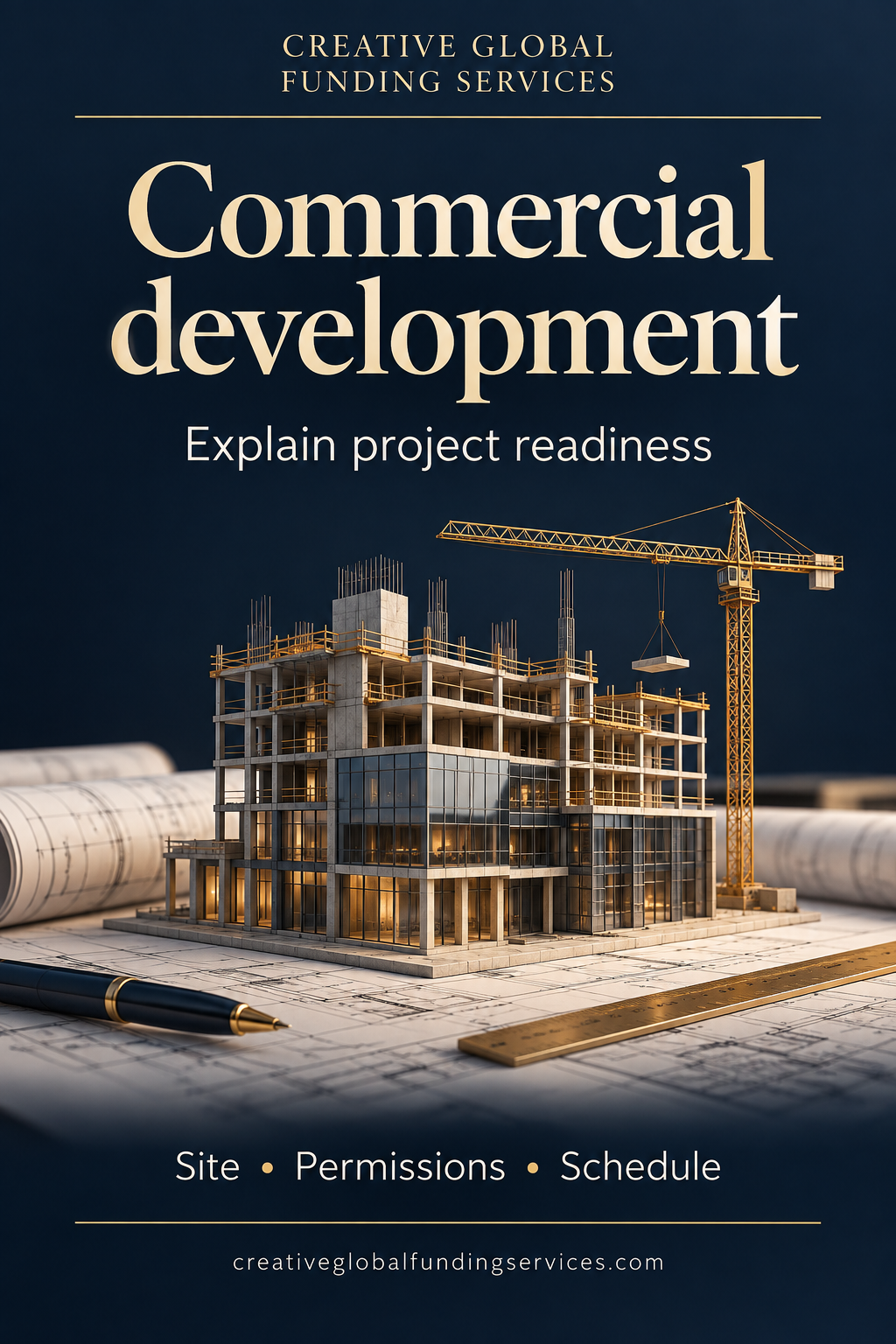
Image disclosure: The featured image is an original AI-generated conceptual campaign illustration. It does not depict an actual financed property or client project.
More Funding Insights

Commercial Property Appraisal Below Purchase Price: How Much Cash Could You Need?
A commercial property appraisal below the purchase price can reduce expected financing. Learn how to calculate the cash gap, check assumptions and prepare your next decision.
Read insight →
Commercial Lease Rollover Budget: Schedule Improvements and Leasing Costs
Build a commercial lease rollover cash budget for tenant improvements, commissions and vacancy. Includes a worked example, delay scenario and checklist.
Read insight →
Commercial Rent Roll: A Financing Preparation Checklist
Prepare a commercial rent roll that connects leases, collections and upcoming expirations. Includes a rent reconciliation example and lease rollover checklist.
Read insight →