
Medical Equipment Replacement Financing: Costs and Downtime
Build a medical equipment replacement funding case with a downtime cash forecast, a worked funding-gap example and a practical proposal checklist.
Medical equipment replacement financing starts with a business question: what cash will the practice need while the old equipment is removed, the replacement becomes usable and collections settle into their new pattern? A low monthly payment alone cannot answer that question. This guide helps healthcare owners build a replacement case around supported costs, a transition schedule and realistic operating assumptions.
Define the replacement case before comparing finance
Explain why the existing asset is being replaced and what the proposed equipment changes operationally. Separate documented maintenance spending and interruption history from estimates of future savings. Ask the clinical and technical team to confirm suitability and readiness requirements; a financing comparison cannot determine which device is clinically appropriate.
Compare feasible alternatives on a common planning horizon: retain and service the current asset, replace it, or use another supported arrangement. Record what each option includes, what it excludes and how long it is expected to remain useful. Avoid assuming that every extra available appointment will become a completed service or a cash receipt.
Build a complete cash-cost schedule
BDC’s equipment-financing guide identifies costs beyond acquisition, including installation, training, maintenance and downtime. Its financing examples are provider-specific and should not be treated as CGFS offers. The useful preparation principle is to examine the whole investment, rather than only the advertised equipment price. Source: https://www.bdc.ca/en/articles-tools/money-finance/get-financing/equipment-financing-101-everything-you-need-know
For the healthcare replacement plan, obtain written quotes for the asset, delivery, removal of the old unit, room changes, installation, testing, staff training and system integration where relevant. Ask what service coverage includes, when it begins and what remains chargeable. Record software subscriptions, consumables and other recurring cash costs separately from the initial project budget.
Put each payment on a calendar. A deposit due on order, a balance due on delivery and a payment triggered by acceptance are different events. Confirm the actual terms rather than assuming payments follow clinical use. Show any trade-in credit only once and state when it becomes available. An anticipated resale should remain separate from confirmed proceeds.
Model downtime without overstating lost cash
Start with the affected services and dates, then ask how the practice will respond. Some appointments may move to another room or a later date; others may be lost. Distinguish delayed collections from permanently lost collections. Identify costs that stop when activity stops and those that continue, such as committed payroll, rent or existing debt payments.
Use aggregate operating and financial data. For a planning worksheet, estimate the reduction in collections and subtract cash costs genuinely avoided over the relevant period. Add any temporary-service or transition spending separately. Do not both subtract the same receipts in the cash forecast and add an identical “lost revenue” charge as an expense.
Worked example: replacement and a delayed restart
Suppose an invented replacement program costs USD $1.20 million for equipment, $120,000 for installation and room work, $30,000 for training and transition support, and $150,000 for contingency and planned transition liquidity. Total uses are $1.50 million. With $400,000 of sponsor cash, the external funding requirement is $1.10 million. These are arithmetic assumptions, not equipment prices, financing terms or industry benchmarks.
Now test an additional interruption beyond the base plan. Assume collections are $90,000 below the original cash forecast, $20,000 of cash costs are avoided, and $10,000 of temporary support is needed. The additional cash pressure is $80,000: $90,000 minus $20,000 plus $10,000. If the $150,000 allowance is entirely available to absorb this amount, $70,000 remains. If part has already been committed, show that reduction first.
If the practice instead wants to retain its entire original allowance, revised uses become $1.58 million and the external requirement becomes $1.18 million, assuming sponsor cash is unchanged. Later recovery of delayed receipts may reduce the lasting impact, but it does not remove a shortfall on an earlier payroll or supplier-payment date.
Test whether savings support the proposed payments
Prepare a separate operating comparison. For example, an invented forecast might show $12,000 per month of avoided repair costs and $8,000 of additional cash contribution after the variable costs of extra activity. Against $4,000 of new recurring support costs, the net improvement before financing payments is $16,000. A hypothetical $14,000 monthly payment would leave a $2,000 difference.
That narrow difference is not proof of affordability. If the additional $8,000 contribution does not materialize, the improvement falls to $8,000 and is $6,000 below the assumed payment. The full practice forecast must also cover its existing obligations. Use actual financing proposals for payments and test timing, service costs and activity assumptions; do not describe this simple calculation as a lender’s debt-service coverage test.
Questions to resolve before a funding submission
- What equipment and related costs are included in the request, and which remain outside it?
- When are deposits, delivery balances, acceptance payments and finance payments due?
- What installation, testing, training and operating-readiness dependencies affect the restart date?
- Which maintenance and support costs disappear, continue or begin under the replacement plan?
- How much activity is delayed, transferred or lost, and what evidence supports those assumptions?
- What cash remains available if the transition takes longer or projected savings fall short?
- What ownership, security, guarantees, end-of-term obligations and early-exit terms apply to each proposal?
Keep the replacement request tied to the wider practice
Reconcile the project schedule to current practice financials and the existing-debt schedule. Identify sponsor contributions without using cash already needed for routine operations. Ask potential providers which costs they can consider and what conditions govern access to funds. A facility intended for specified equipment should not be assumed to cover every operating or transition need.
For a project that also adds a location or service line, use the broader clinic-opening framework alongside the replacement analysis: https://www.creativeglobalfundingservices.com/clinic-expansion-financing-budget-for-opening-and-cash-flow/
Frequently asked questions
Is the cheapest equipment quote always the lowest-cost option?
No. Compare equivalent scope, recurring support, transition effects and contractual obligations over the same period. A lower initial price may exclude costs included in another quote.
Should projected extra appointments be counted as cash immediately?
No. Explain expected completed activity, collectible amounts, variable costs and collection timing. Test a scenario with no additional activity so the replacement case does not depend entirely on growth.
Does a strong replacement worksheet guarantee finance?
No. It helps explain the request, but providers make their own decisions on the business, asset, cash flow, documentation and proposed terms.
Discuss qualified healthcare funding needs with CGFS
Creative Global Funding Services reviews qualified business and project funding requests of USD $1 million or more and connects applicants with potential capital providers. Bring the replacement scope, supplier quotes, transition schedule and cash forecast. Funding is subject to independent due diligence, acceptable terms, documentation and final approval. Start a conversation: https://www.creativeglobalfundingservices.com/request-funding.php
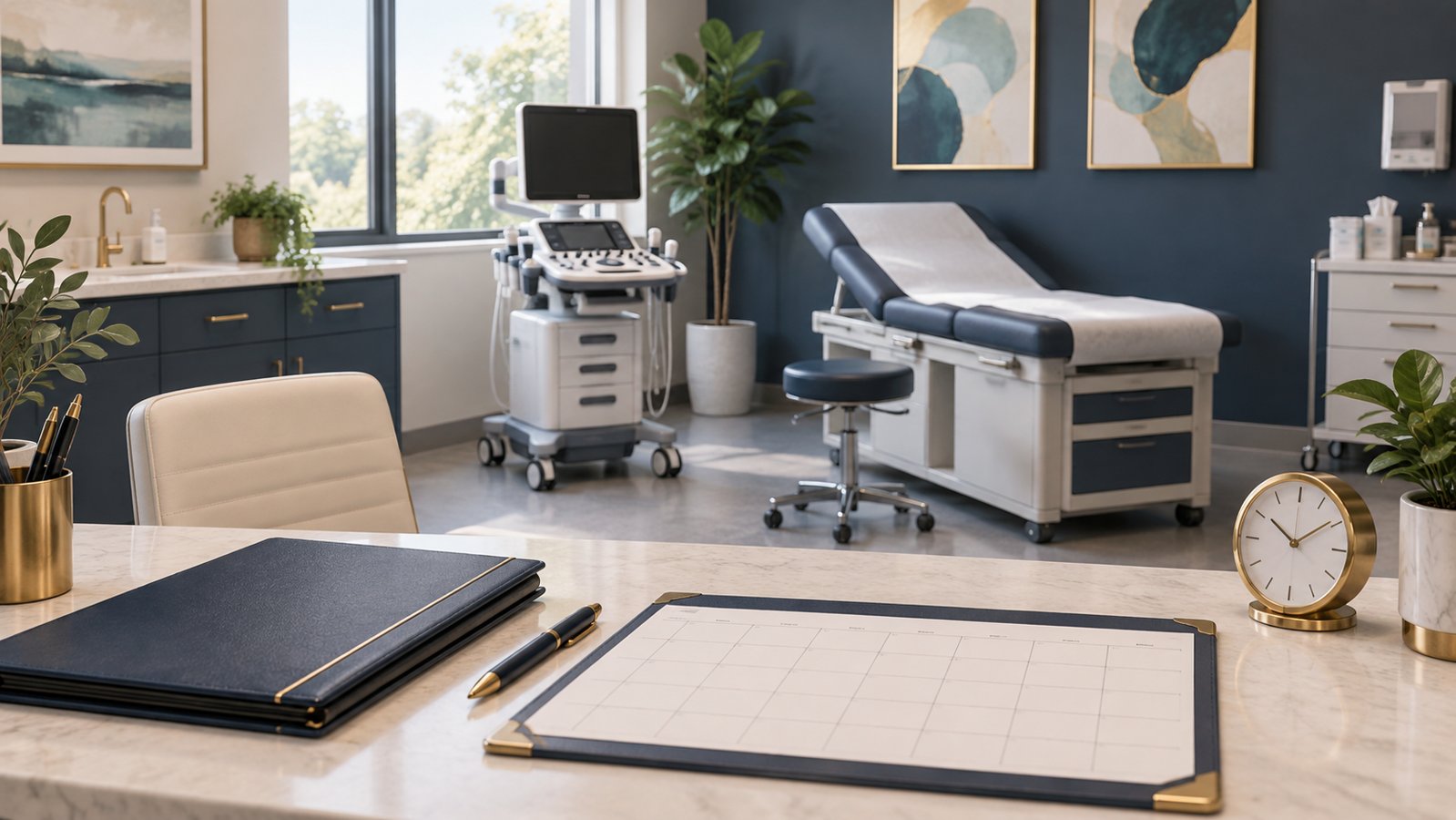
This is general business funding education, not clinical or device-selection advice. Featured image: original AI-generated conceptual illustration of a fictional clinic, not an actual CGFS client or financed facility.
More Funding Insights
Clinic Expansion Financing: Budget for Opening and Cash Flow
A clinic expansion needs more than construction funding. Learn to budget for equipment, opening costs and the cash gap before patient revenue is collected.
Read insight →
Healthcare Funding in the USA: A Business Guide | CGFS
Healthcare organizations need capital for acquisitions, facilities, equipment, staffing, technology, and day-to-day liquidity. This guide explains the principal healthcare funding options in the USA and how borrowers can prepare a stronger financing request.
Read insight →
Sponsor Experience for Funding: What Evidence Should You Provide?
Unsure how to demonstrate sponsor experience for funding? Connect relevant projects, personal responsibilities and documented outcomes with this practical summary format.
Read insight →