
Used Equipment Financing: What to Verify Before You Buy
Is a cheaper used machine really ready for your expansion? Check condition, support and remaining useful life before preparing an equipment financing request.
Before seeking used equipment financing, verify that the specific asset can do the required work, establish its condition and support needs, and explain how long you expect to use it. A lower asking price is only useful if the machine can support the expansion without unplanned repairs or an early replacement. Build an evidence file before treating the purchase price as the financing requirement.
Start with the asset, not just the advertisement
Create a one-page asset record: manufacturer, model, serial number, configuration, location, seller and quoted price. Attach the dated listing and quote. Record what is included, such as tooling, accessories, software or service arrangements, and what remains unconfirmed. Ask the seller to explain any differences between the listing and the unit being offered.
Describe the job the equipment must perform in your business. An advertised capacity does not establish the output your process will achieve with your materials, operators and product specifications. Write down the operating assumptions you want a qualified inspector or supplier to assess. This gives the technical review a business purpose instead of producing a generic condition report that nobody connects to the forecast.
Turn inspection findings into decisions
Arrange an appropriately qualified technical assessment for the equipment type and intended use. Ask for the scope and limitations in writing: which components were examined, whether operation was observed, which tests were performed and what could not be assessed. A photograph, seller assurance or brief demonstration is not equivalent to a comprehensive inspection. Do not describe untested items as satisfactory.
Organize findings into three practical groups: work needed before service, planned work during ownership and unresolved questions. Give each material item an evidence reference, responsible person, next action and decision date. If a repair is necessary before use, request a scoped estimate and availability date. If the condition remains uncertain, identify what further inspection would resolve it rather than quietly adding an unsupported allowance.
Check parts, support and remaining useful life
BDC’s equipment-purchasing guidance recommends checking manufacturer support, spare parts and accessories when considering used or refurbished equipment. It also encourages buyers to assess suitability and applicable safety and reliability standards rather than choosing on price alone. Source: https://www.bdc.ca/en/articles-tools/money-finance/get-financing/business-equipment-how-shop-wisely
For your review file, record who confirmed support and the date of that confirmation. Ask about service availability, critical replacement components and any software or control-system requirements relevant to the asset. Separate a seller’s statement from a manufacturer response or a written service proposal. A part that can be ordered is not necessarily available within your acceptable downtime window.
Remaining useful life means the period you reasonably expect the equipment to remain useful in your operation under stated assumptions. Ask qualified advisers to support that estimate. Keep it distinct from the machine’s age, an accounting depreciation schedule and a hoped-for resale price. If your forecast assumes six years of productive use, show the evidence and maintenance assumptions behind those six years.
Connect the asset evidence to the financing discussion
BDC describes equipment quotations, financial information and forecasts as elements of a financing application and notes the relationship between repayment duration and equipment lifespan. Its guidance is a useful preparation reference, not a statement of CGFS terms or a guarantee that any lender will accept an older asset. Source: https://www.bdc.ca/en/articles-tools/money-finance/get-financing/equipment-financing-101-everything-you-need-know
Ask the prospective provider which assets and related costs it will consider, what valuation or inspection evidence it requires, and what conditions apply before funds are available. Discuss the proposed repayment schedule alongside the supported operating life. Do not assume that a seller’s price equals the value a provider will recognize or that a long repayment period is available simply because it produces a smaller monthly payment.
Fictional comparison: the cheaper machine needs more work
Consider two used production assets with the same intended role. Machine A has a USD 1,000,000 asking price and a scoped USD 180,000 pre-service repair estimate. Machine B costs USD 1,120,000 and has a USD 40,000 pre-service repair estimate. On those two known items, A totals USD 1,180,000 and B totals USD 1,160,000. B is USD 20,000 lower despite its higher asking price. These figures are invented, not market benchmarks or real CGFS transactions.
That arithmetic is a screening step, not the purchase decision. Suppose A’s critical component lead time is unconfirmed while B’s inspection has a limitation affecting a different major component. Neither uncertainty disappears because the known costs have been added correctly. The next action is to resolve or explicitly model those questions, not announce that B is automatically the better asset.
Keep delivery, installation, operating cash and future maintenance in the broader project comparison. Compare both options over the same intended operating period and disclose any residual-value assumptions. If lost production affects expected receipts, do not also count the same reduction as a separate cash expense. For the implementation budget after the condition review, see the CGFS equipment installation guide: https://www.creativeglobalfundingservices.com/equipment-installation-budget-beyond-purchase-price/
Used equipment financing preparation checklist
- Asset identity: quote, serial number, configuration, location, seller and clearly listed inclusions.
- Business fit: required work, operating assumptions and evidence that the equipment suits the intended process.
- Condition evidence: dated inspection scope, findings, limitations and available maintenance history.
- Remediation plan: supported repair scope, cost, lead time and responsibility before the machine enters service.
- Support and life assumptions: parts and service evidence, expected operating period and planned major work.
- Funding discussion: complete project costs, business financials, cash forecast and provider-specific requirements still to be confirmed.
Frequently asked questions
Does a recent refurbishment remove the need for an inspection?
Clarify exactly what was refurbished, by whom and with what supporting records or warranty. The term alone does not explain the condition of every component. Ask your technical adviser what remains to be assessed for your intended use.
Should the loan term match the age of the machine?
Discuss the proposed repayment period in relation to expected future use, cash generation and provider requirements. Calendar age alone does not establish remaining useful life or the terms a provider will offer.
Can I submit a funding inquiry while technical questions remain open?
You can describe the actual stage of the purchase and identify outstanding work. Clearly label estimates and unresolved findings. An inquiry or preliminary review does not mean the asset or financing has been approved.
Bring a supported expansion request to CGFS
CGFS reviews business and project financing requests of USD 1 million or more. Summarize the asset, its business purpose, total capital requirement and material unresolved findings for an initial discussion. Submitting an inquiry does not constitute a commitment to lend, invest or arrange financing; opportunities remain subject to review, due diligence, underwriting and final approval. Start your inquiry: https://www.creativeglobalfundingservices.com/request-funding.php
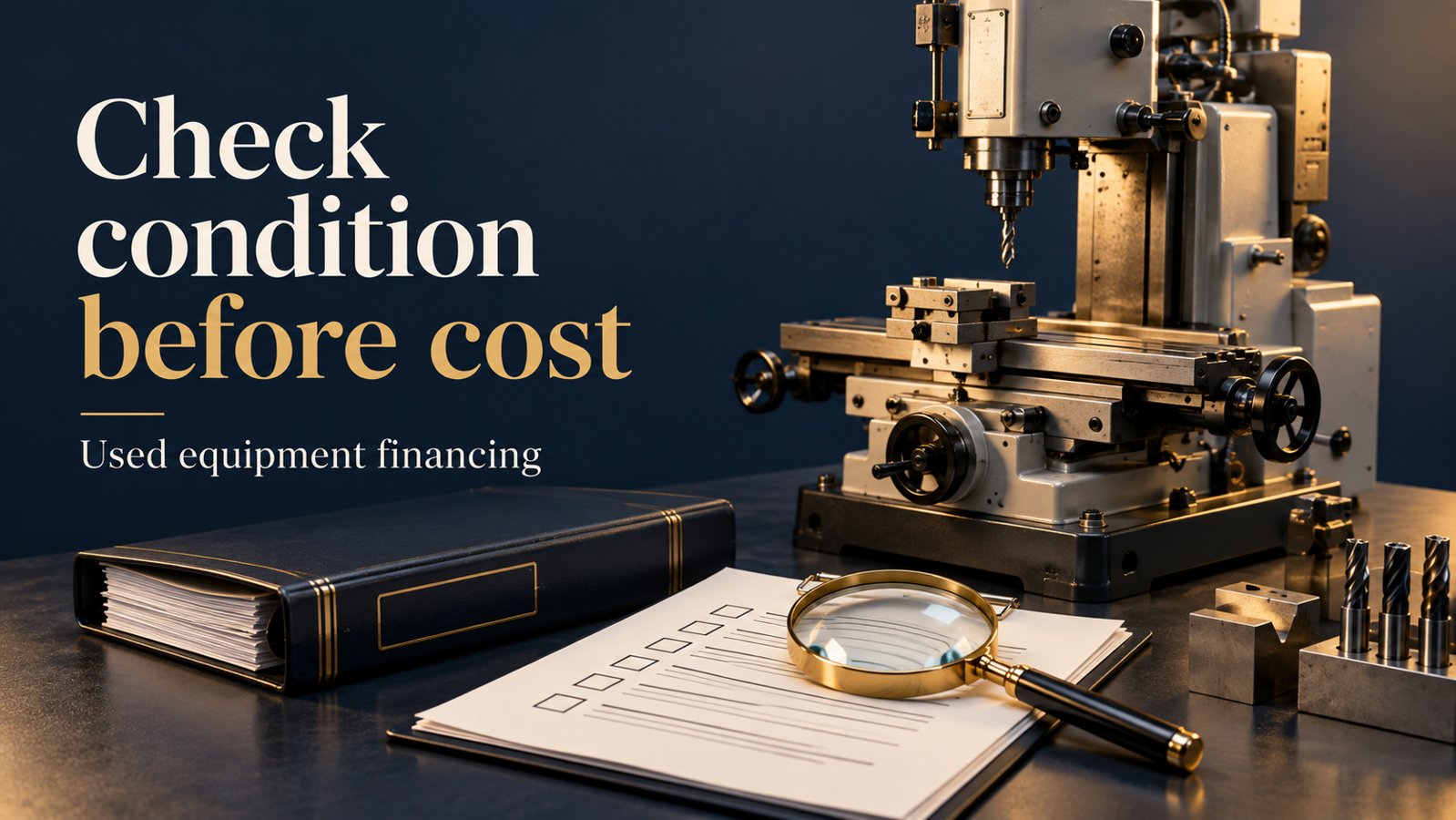
Featured image: original AI-generated conceptual illustration of a milling machine, maintenance binder, inspection checklist and magnifying glass. It does not depict a real client or financed asset.
More Funding Insights

Equipment Lease Ending: How Much Cash Will You Need?
An expiring equipment lease can trigger more than a final payment. Map notice dates, buyout or return costs, and production continuity before choosing your next step.
Read insight →
Equipment Expansion Financing: Prove the Capacity and Demand Case
Before financing a larger production line, test the real bottleneck, customer demand and cash timing. Use this example and checklist to prepare a clearer expansion case.
Read insight →
Equipment Installation Budget: Costs Beyond the Purchase Price
Build an equipment installation budget covering delivery, site readiness, commissioning and operating cash, with a worked example and funding checklist.
Read insight →