
DSCR and Debt Yield: How Commercial Property Loans Are Sized
Understand how commercial real estate lenders compare property income with debt payments and loan balances, with clear calculations and practical preparation steps.

Two measures, two different questions
For an income-producing property, a financing conversation should connect the requested loan to the cash flow supporting it. Debt-service coverage ratio (DSCR) compares net operating income with annual debt payments. Debt yield compares that income with the loan amount. They answer related questions, but they are not interchangeable.
The OCC's Commercial Real Estate Lending handbook explains both measures and recommends considering debt yield alongside DSCR, loan-to-value and other underwriting criteria. Thresholds depend on the property, lender and transaction; the examples below are hypothetical, not CGFS terms or approval criteria.
Calculate DSCR and debt yield
DSCR = annual net operating income / annual debt service. Debt yield = annual net operating income / loan amount, expressed as a percentage.
Suppose an office property has $900,000 of annual NOI, a proposed $8 million loan, and $600,000 of annual debt service. Its DSCR is 1.50x: $900,000 divided by $600,000. Its debt yield is 11.25%: $900,000 divided by $8 million. Debt service should reflect the payments required under the scenario being tested, including principal where applicable.
Now increase annual debt service to $750,000 while leaving income and the loan balance unchanged. DSCR falls to 1.20x, but debt yield remains 11.25%. This illustrates why a lower initial payment can improve coverage without changing the amount of debt relative to property income.
Work backward to an illustrative loan size
Start with a supported income figure. If a hypothetical lender requires 1.25x DSCR on $900,000 of NOI, the corresponding maximum annual debt service is $720,000. Turning that payment amount into a loan balance requires assumptions about interest, amortization and payment frequency. The DSCR calculation alone does not produce a loan amount.
Separately, assume a hypothetical 10% minimum debt yield. Dividing $900,000 by 10% gives a $9 million loan amount under that test. Suppose another illustrative limit permits 65% loan-to-value against an accepted $12 million valuation. That calculation supports $7.8 million. The property would still need to satisfy the payment-based test and other conditions; the largest number is not the borrowing entitlement.
For a purchase at $12 million, a $7.8 million loan would leave $4.2 million of purchase consideration to fund from other sources, before closing costs and reserves. A sources-and-uses schedule makes that gap visible early. Adding subordinate debt may change coverage, consent requirements and overall risk, so do not assume it automatically solves the equity requirement.
Check the income behind the ratios
Before debating a ratio, reconcile the property's rent roll, leases and operating statements. Show which amounts reflect collected income, contractual rent, vacant space, concessions or a future leasing assumption. Separate historical performance from a stabilized forecast so the reviewer can see what must happen before the projected income exists.
Build an assumption register: each major revenue or expense item, its supporting document, the period covered, and the reason for any adjustment. Ask the capital provider how it treats replacement reserves, management costs, tenant improvements and leasing costs in its analysis. A clearly labeled calculation is easier to discuss than an unexplained headline NOI.
For a development or major repositioning, describe the route to occupancy and the cash needed before stabilization. A projected stabilized ratio does not demonstrate the ability to pay today's construction or operating obligations.
Stress-test the repayment and exit plan
Return to the $900,000 NOI and $600,000 annual debt service example. A 15% income reduction produces $765,000 NOI and 1.275x DSCR. If debt service also rises to $750,000, coverage falls to 1.02x. With the $8 million loan unchanged, debt yield becomes about 9.56%. These are arithmetic scenarios, not forecasts.
Use scenarios that reflect the property: a major tenant leaving, slower leasing, higher expenses or a different refinancing rate. Record the resulting cash shortfall and the proposed response. An uncommitted future capital contribution should be labeled as conditional.
The OCC's refinance-risk guidance highlights the importance of evaluating repayment at maturity when a loan does not fully amortize. For a borrower, the practical question is whether the remaining balance can be repaid or refinanced under defensible assumptions. A manageable current payment does not by itself establish a reliable exit.
Prepare for a funding discussion
• State the requested amount, use of funds, property location and timing.
• Provide current rent roll, leases, operating history and an explanation of NOI adjustments.
• Show proposed annual debt service and the assumptions used to calculate it.
• Present DSCR, debt yield and valuation-based leverage consistently.
• Reconcile purchase or project costs with debt, equity, fees and reserves.
• Include downside scenarios and the proposed maturity or refinancing plan.
Ask which test limits the proposed loan, what must be verified before a term sheet becomes actionable, and what conditions could change the amount. Ratio analysis supports a conversation; it does not replace underwriting, valuation or documentation.
Frequently asked questions
Does a higher DSCR guarantee approval?
No. A lender also evaluates the property, borrower, collateral and transaction. A ratio can look strong while key assumptions remain unsupported.
Is debt yield the same as a capitalization rate?
No. In these calculations, debt yield divides NOI by debt; a capitalization rate relates NOI to property value. The denominators serve different purposes.
Can interest-only payments make a loan appear easier to support?
They can improve current DSCR relative to amortizing payments. Review the later payment schedule and remaining principal at maturity as well.
Discuss commercial real estate financing with CGFS
Creative Global Funding Services reviews qualified funding requests of USD $1 million or more and connects applicants with potential capital providers. Bring a property summary, requested amount, operating information and sources-and-uses schedule to the discussion. Funding remains subject to independent due diligence, acceptable terms, documentation and final approval.
Financing solutions: https://www.creativeglobalfundingservices.com/solutions.php
Related reading: https://www.creativeglobalfundingservices.com/commercial-real-estate-capital-stack-explained/
Contact: https://www.creativeglobalfundingservices.com/contact.php
This is general funding education. Specific structures, calculations and requirements vary by capital provider and jurisdiction.
Sources
OCC, Commercial Real Estate Lending, Version 2.0, page 43: https://www.occ.gov/publications-and-resources/publications/comptrollers-handbook/files/commercial-real-estate-lending/pub-ch-commercial-real-estate.pdf
OCC, Commercial Lending: Refinance Risk, Bulletin 2024-29: https://www.occ.gov/news-issuances/bulletins/2024/bulletin-2024-29.html
More Funding Insights

Commercial Property Funding Brief: A Practical Worksheet
Build a clear property funding brief covering the asset, intended use, capital requirement, supporting evidence and open questions before an initial funding discussion.
Read insight →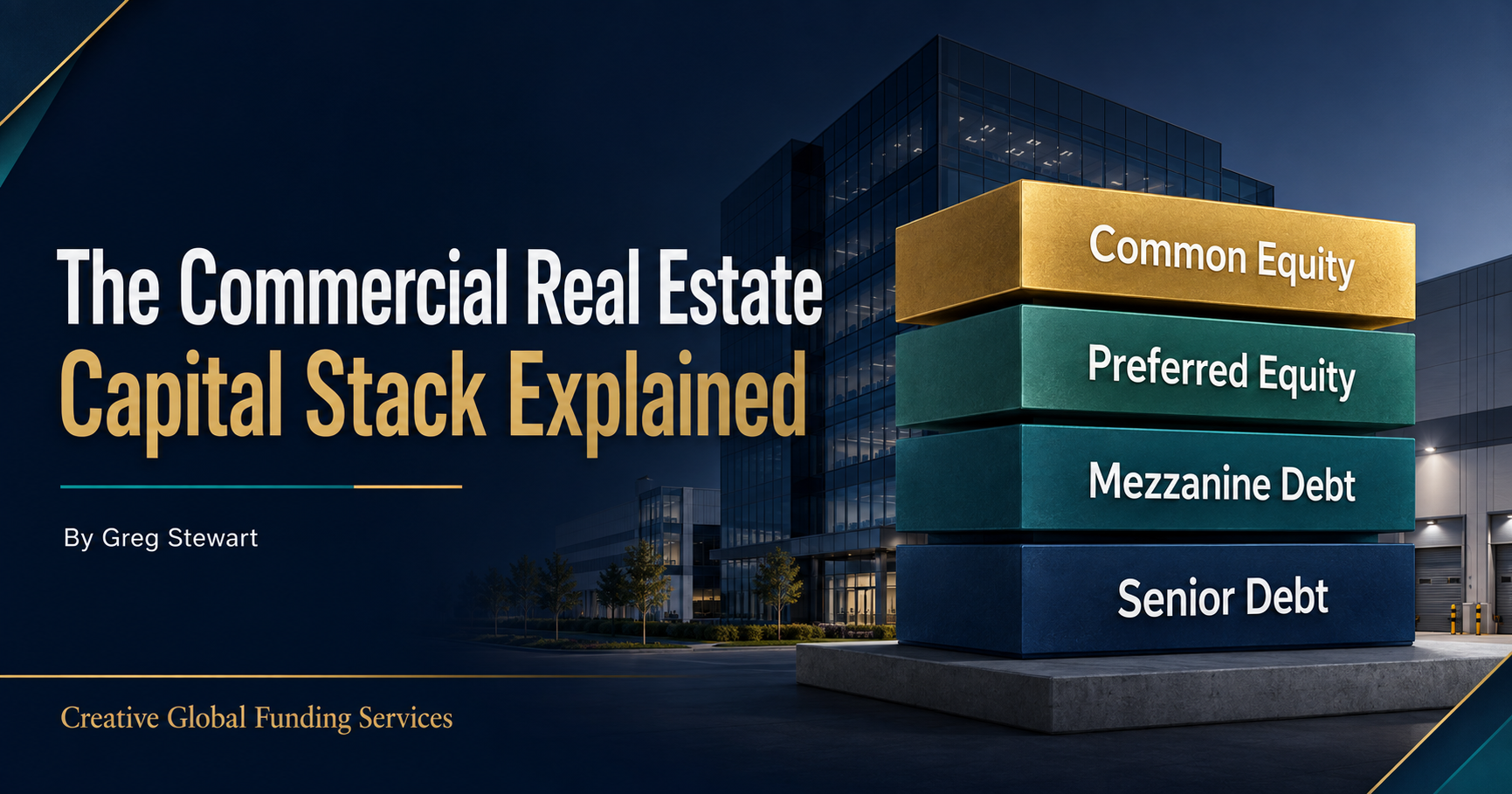
The Commercial Real Estate Capital Stack Explained
Understand how senior debt, mezzanine financing, preferred equity, and common equity work together, with a $10 million project example and practical financing considerations.
Read insight →
Commercial Construction Financing: Requirements, Terms and Process
Commercial construction financing is built around project readiness, sponsor strength, a verified budget and a credible repayment strategy. This guide explains the requirements, terms and process for qualified projects.
Read insight →