
Mining Project Funding: What If Mineral Recovery Falls Short?
Could lower mineral recovery weaken your mining funding plan? Trace recovery through payable output, cash receipts and debt payments with a worked example.
Could a lower-than-planned mineral recovery leave a mining project short of cash? Test it by changing the supported recovery assumption, recalculating payable output and receipts, and then rerunning costs and debt payments by period. A percentage in a technical report is not cash in the bank. For mining sponsors, the useful funding question is whether the proposed repayment plan still works when less of the contained metal becomes saleable product.
This guide offers a practical sensitivity worksheet for a funding discussion. It does not establish an achievable recovery rate, a mineral estimate or a lending threshold. The worked example uses invented assumptions to show the arithmetic.
Keep grade, recovery and payability separate
Feed grade describes how much of the target material is present in the material entering the process. Metallurgical recovery describes the proportion recovered through the specified process. Payability describes the portion credited for payment under the relevant commercial terms. A model should identify the boundary and units for each calculation rather than using these terms interchangeably.
For a simple single-metal illustration, contained metal equals feed tonnes multiplied by metal grade expressed as a decimal. Recovered metal equals contained metal multiplied by recovery. A separate commercial calculation then converts recovered output into payable quantities and receipts. Actual arrangements can include deductions and other adjustments, so the project team should document the applicable formula.
Ask what supports the recovery assumption
CIM’s 2022 mineral-processing guidelines emphasize representative sampling, variability and the relationship between feed characteristics, recovery and processing costs. They also address producing a saleable product. These are technical evidence questions for the responsible mineral-processing professionals, rather than a checklist that proves financing eligibility. Source: https://mrmr.cim.org/media/1157/cim-practice-guidelines-for-mineral-processing-2022.pdf
For the funding model, attach an assumption register showing the exact report, page, date, process boundary and responsible reviewer behind the selected recovery input. Ask the technical team to explain how the input applies to the production periods being forecast. Record unresolved questions and the work needed to resolve them; do not silently substitute a favorable result from a different test or project.
Keep report classifications intact when presenting the wider project. The companion CGFS guide explains the distinction between mineral resources and reserves: https://www.creativeglobalfundingservices.com/mineral-resources-vs-reserves-funding-evidence/
Worked example: five percentage points change the cash picture
Consider a fictional copper project processing 100,000 tonnes of feed in a year at a copper grade of 1%. That means 1,000 tonnes of contained copper. Assume 90% recovery in the base case and 85% in a downside case. Recovered copper falls from 900 tonnes to 850 tonnes. The change is five percentage points of recovery and 50 tonnes of recovered metal; it is not a five-percent relative reduction in recovered output.
For this simplified illustration only, assume a flat 95% payable factor and a price of USD $8,000 per tonne of payable copper. Base-case payable copper is 855 tonnes, producing $6,840,000 before charges. Downside payable copper is 807.5 tonnes, producing $6,460,000. The difference is $380,000. The rate, price and commercial factor are invented assumptions, not current quotations or typical contract terms.
Now assume all sales are collected within the year, with no inventory or receivables movement. In both cases, assume $5 million of non-overlapping cash outflows for operating costs, selling charges, royalties, taxes and sustaining expenditure. Hold these outflows constant solely to isolate the recovery effect. Cash remaining before debt service is then $1,840,000 in the base case and $1,460,000 in the downside case.
With annual principal and interest payments of $1.5 million, the base case leaves $340,000 after debt service while the downside case has a $40,000 shortfall before any additional liquidity buffer. Dividing the illustrated pre-debt-service cash by debt service gives approximately 1.23 times and 0.97 times. These are simplified coverage calculations, not a contractual DSCR definition or an approval test.
Turn annual arithmetic into a cash schedule
An annual total can hide a payment problem. Add monthly or quarterly opening cash, collection dates, operating payments, capital spending and scheduled debt service. Identify the lowest unrestricted cash balance, not just the year-end balance. Keep restricted cash separate and show proposed funding separately from committed, drawable sources.
For example, a shipment produced near year-end may not be paid for until the following year. Its modeled sales value cannot cover an earlier loan installment unless another usable cash source bridges the timing. Conversely, an opening cash balance could cover a temporary shortfall even when that year’s operating cash is insufficient. Show the source, restrictions and depletion explicitly.
The World Bank’s project-finance guidance describes debt-service coverage as a period-specific comparison of available cash and debt obligations, and discusses sensitivity testing. That is useful context for this exercise; the actual financing documents determine definitions, testing dates and consequences. Source: https://ppp.worldbank.org/financing/issues-in-project-financed-transactions
Test linked assumptions before proposing a response
After isolating recovery, build a combined downside case with the technical and commercial teams. Check whether the assumed change also affects throughput, consumables, product quality, selling deductions or expenditure. Do not simply lower one spreadsheet cell and assume every other input remains valid. Keep the isolated test as a diagnostic and label the combined case separately.
Document each proposed response with its cost, evidence, owner and decision date. Additional testwork, revised operating plans or a different funding structure may need evaluation, but none should be described as a guaranteed solution. Do not assume that higher commodity prices will rescue the downside case or that a capital provider will automatically fund the difference.
A concise funding summary should show the base case, the recovery-only downside and the combined downside using the same reporting dates and units. Explain which inputs are evidence-based estimates, which are contractual terms and which remain unresolved. This makes the discussion more useful than presenting one optimistic cash-flow line.
Mining sponsor preparation checklist
- Identify the recovery input, process boundary, units and exact technical source.
- Have the responsible technical team review its use in the production forecast.
- Separate contained, recovered and payable quantities in the model.
- Document price assumptions, selling adjustments and collection dates.
- Recalculate costs and cash available for each scheduled debt payment.
- Record downside gaps, available liquidity and proposed responses without assuming approval.
Frequently asked questions
Does higher grade guarantee stronger repayment capacity?
No. The funding forecast must also reflect processing outcomes, commercial terms, costs and cash timing. Review those inputs together rather than treating grade alone as a measure of borrowing capacity.
Can a laboratory result be used directly as the operating forecast?
Ask the responsible technical professional to assess its suitability for that use and explain the limitations. Preserve the test conditions and report qualifications in the funding materials; do not present an isolated result as assured production.
Does coverage below one mean financing is impossible?
The illustrative ratio signals that the modeled period’s cash does not cover the assumed debt service. It does not decide financing eligibility. The wider funding structure, liquidity, evidence and provider-specific assessment still matter, and no outcome is guaranteed.
Prepare a mining funding discussion
Bring the technical assumption register, production and collection schedule, sensitivity cases, requested amount and proposed use of funds. Creative Global Funding Services reviews business and project financing requests of USD $1 million or more. Submitting an inquiry is not a commitment to lend, invest or arrange financing; all opportunities remain subject to review, due diligence, underwriting and final approval. Start here: https://www.creativeglobalfundingservices.com/request-funding.php
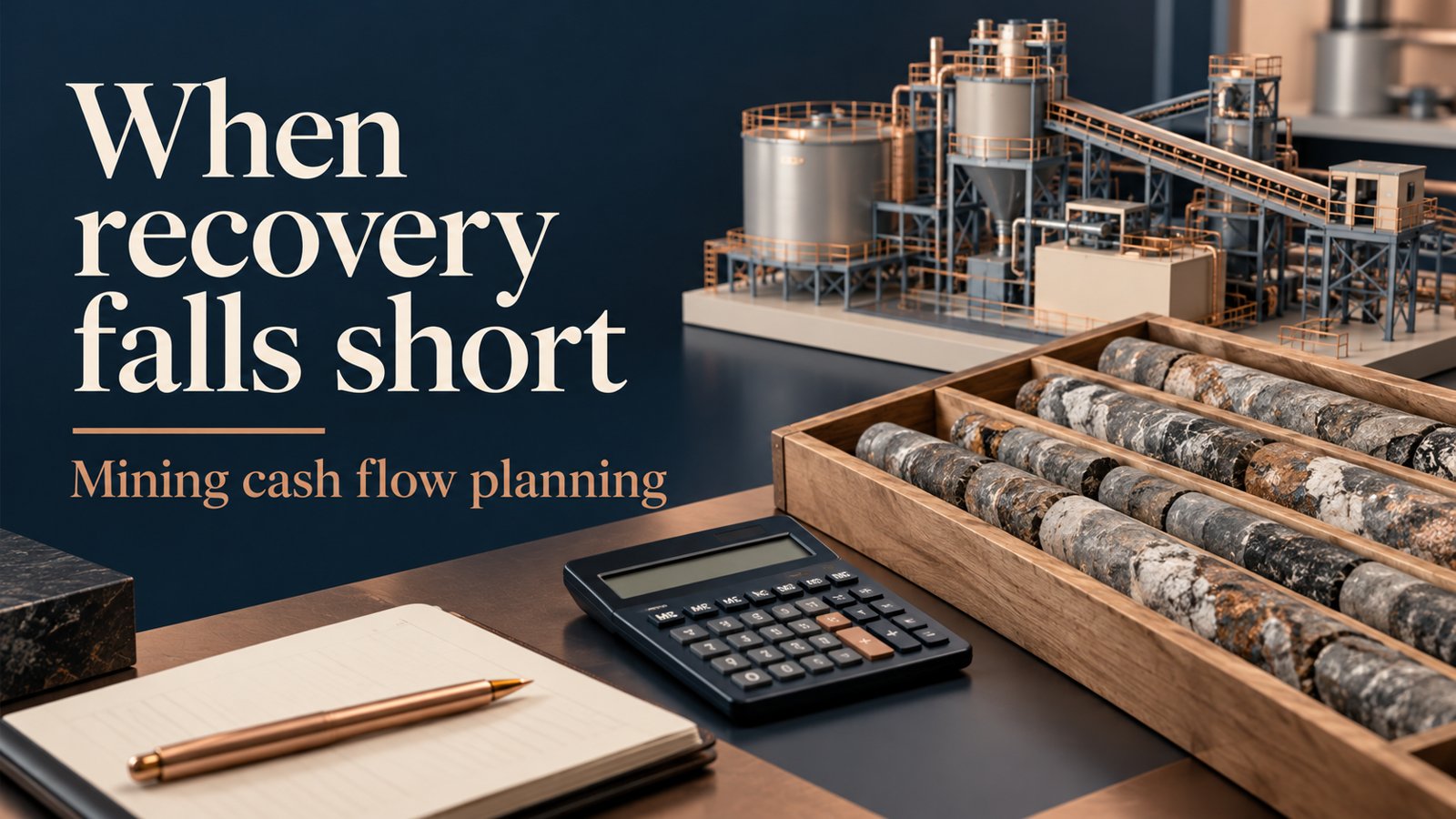
This article provides general funding education and fictional calculations, not project-specific technical advice. The original AI-generated featured image shows conceptual core samples, a processing-plant model and a calculator, not a real CGFS client or financed mine.
More Funding Insights

Mine Closure Costs: Plan Financial Assurance and Cash Needs
Prepare a clearer mining funding request by separating closure cost estimates, financial assurance and cash requirements, with a worked example and checklist.
Read insight →
Mineral Resources vs Reserves: A Mining Funding Evidence Guide
Understand mineral resources versus reserves and prepare a traceable mining funding summary, with a worked example, evidence register and practical checklist.
Read insight →
Mining Project Funding: Budget for the Next Milestone
Connect a mining funding request to a defined technical milestone, a supported budget and a clear decision point, with an illustrative funding-gap calculation.
Read insight →